
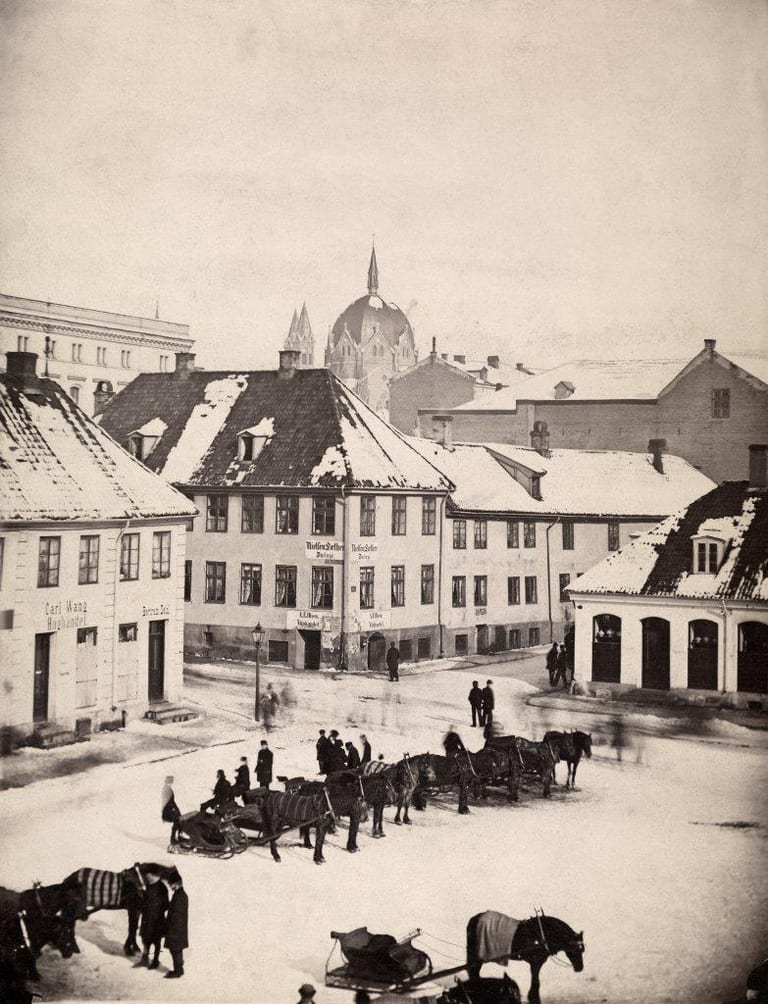
The clinking of glasses and cutlery, large steaming pots of soup, the smell of freshly baked bread, mackerel and aquavit. The women of the inn, their cheeks flushed red, hurry back and forth balancing trays full of glasses. Outside, thirsty horses neigh, bells jingle and the stairs creak. They have arrived at Stortorvet with horses and sleighs from all across the inland regions, with plenty to sell and plenty to buy. The scent of gingerbread drifts across the square as children throw snowballs at one another. But it is cold outside, so stepping into the inn brings welcome warmth to frozen, stiff bodies.
It may not be quite like that anymore, but few places in Oslo have preserved their historic character as well as Stortorvets Gjæstgiveri and Grensen 1.
The 1700s
In 1689, Christiania was struck by a major fire, and the city’s church, the Church of the Holy Trinity, which stood by Christiania Torv, caught fire. Although the church was not completely destroyed, it was decided not to rebuild it. Instead, a new church was to be constructed further to the northeast, where it would not obstruct the view of the city from Akershus Fortress. A new church was therefore built outside the city walls, on what would later become Stortorvet, which eventually also took over the city’s main market-square function. The church, known as the Church of Our Saviour — today Oslo Cathedral — was built between 1694 and 1699.
The area known as Grensen, which at the time was called Grændsen, was a suburb of Christiania and lay outside the city limits. The same was true of both the new church and Stortorvet.
The relocation of the church from Rådhusgata to the Stortorvet area brought about a major change in the movement and everyday life of the city. Of all the city’s residents who understood the significance of this, only one acted on it. He was farsighted enough to build a “town house” on the plot between Møllergata and Grubbegata at the same time as the new church was being constructed. The building, which is today Stortorvets Gjæstgiveri at Grensen 1, was completed around the year 1700.
What we know today as Stortorvet was, until 1736, little more than a marsh. At that time, the city’s marketplace was located outside Rådhusgata 19, and trade there had grown so much that there was a general desire for a larger square. As church and marketplace traditionally belonged together in old market towns, it was natural that the square should follow the church. However, it took a long time before the citizens were fully prepared to give up the old market square by Rådhusgata, as this was a much livelier traffic area than the district surrounding the new church.
The church had been built outside the city walls, and around the year 1700 there was a large pond where Stortorvet stands today, as well as defensive moats by the ramparts close to the square. These were filled in when the fortifications were demolished, and the area was subsequently used for dumping rubbish and waste.
Around 1730, work began on levelling the square, and in 1735 it was decided that the citizens of Christiania should turn up with picks and shovels, while the city’s prominent residents were required to provide 2,000 loads of earth and stone so that the square could be established. The decision was not particularly well received, but the work went ahead nonetheless.
The square was officially inaugurated on the first Tuesday of February 1736, at the same time as the Christiania market was moved there. This had major consequences for the future of Grensen 1, as much of the farmers’ trade was now relocated to the area directly outside the property, rather than remaining centred in Kvadraturen.
Old maps show that the building known today as Stortorvets Gjæstgiveri was rectangular in shape and stood between Møllergata and Grubbegata, with its main façade facing Grensen, exactly as it does today. At the time, however, the property was surrounded by a fence that separated it from the road outside. The side wings facing Grubbegata, Møllergata and the gable of the neighbouring property at Møllergata 1 were added later. There are no exact records showing when the various sections were built or when they were joined together as a single building, but maps and title deeds date these developments to the period between 1736 and 1860.
The first known owner by name was Anders Hansen Holst, although ownership changed frequently. In the years that followed, the property was owned by prominent members of the upper classes, and ownership periods were generally short, averaging around 12 years between 1700 and 1880. One of these owners was Andreas Lie, who worked as a customs official in Christiania. He is described as a wealthy man who maintained an elegant and sociable household. Later in life, he enthusiastically took part in celebrations and gatherings held in honour of the French Revolution in 1792–93.
In 1768, the property was purchased by the merchant Claus Tollefsen. That same year, the authorities took an important step for the future of the property, and on 18 March 1768 it was officially incorporated into the city. This meant that the owners were now entitled to conduct regular merchant trade, and the assessed value of the property was increased. The neighbouring properties did not receive the same privileges until 1784.
The merchant Jens Edsleff is recorded as the owner of the property from 1769 to 1783. Edsleff traded with farmers by Vaterland Bridge and was considered a very wealthy man by the standards of the time. He was married to Hedvig Sofie Colling, sister of the wealthiest merchant in Vaterland, Anders Colling, better known as “Rotteanders”. Edsleff moved in the city’s most distinguished social circles and ranked among Christiania’s largest taxpayers.
The 1800s
Christian Heyerdahl was the merchant who owned the property for the longest period. He held Grensen 1 for 30 years, from 1802 to 1832. Although he had put the property up for auction in 1830, the title deed was not transferred to the next owner until two years later.
Originally, there were three separate properties facing Møllergata and Grubbegata, but during Heyerdahl’s ownership they were all brought together under his control and have never since been divided. They were all given the address Grensen 1.
Merchant Christian Heyerdahl belonged to Christiania’s commercial elite, and during his time many distinguished gatherings were held at the old Stortorvets Gjæstgiveri. He was, among other things, a close friend of Prince Friedrich of Hesse. During the prince’s stay in Norway in 1813, he entered into what is described as Norway’s only morganatic marriage, marrying Baroness Clara von Lilliencron “with his left hand”. Christian Heyerdahl was one of only two witnesses to the ceremony.
On 17 May 1829, Stortorvet became the scene of the famous “Battle of the Square”. The unrest began after King Karl Johan had banned any celebration of the day. When a large crowd greeted the arrival of the steamship Constitutionen that afternoon with cheers and singing, the authorities became nervous.
The peaceful crowd moved on to Stortorvet, where they were driven away by summoned cavalry and infantry. Karl Johan sent military forces into the crowd, striking at people with sabres. Henrik Wergeland had his student uniform damaged during the disturbances.
It is quite possible that many people on the square were forced to seek refuge inside Gjæstgivergården. The public reaction created by the “Battle of the Square” helped pave the way for the later recognition and celebration of 17 May.
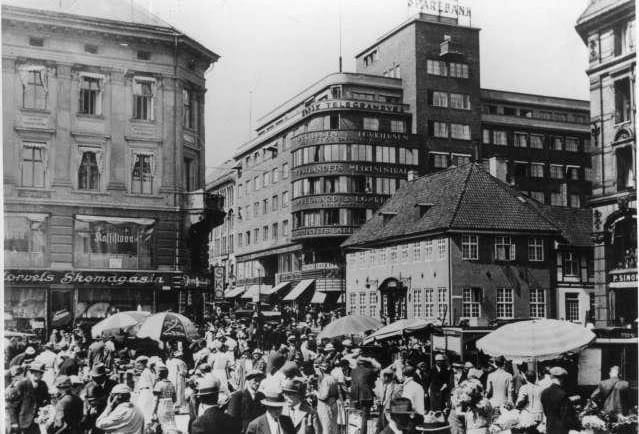
In 1846, ownership passed to Ole Josef Møller. He invested considerable sums in the property and was responsible for building the beautiful gallery that still runs along the inner courtyard. He also raised the half-timbered building facing Grubbegata to two storeys, giving it the appearance it still has today.
Møller was one of the driving forces behind the revival of Norway’s Constitution Day celebrations on 17 May. Funding for the festivities was raised through private donations, and the yellow house by the square was one of the places where contributions poured in. To this day, the building remains closely associated with the celebration of 17 May.
From 1848 until his death in 1851, Andreas Tofte was a co-owner of Grensen 1. In 1837, Tofte became the first mayor of Christiania. Today, he is best known for the orphanage institution he donated to the city, now located on Helgøya in Ringsaker municipality in Hedmark. The institution bears the name Toftes Gave and is still in operation today, now as a residential home for people with developmental disabilities.
Tollef Olsen, who owned the house for 11 years, also made major changes to the property. He rebuilt the wing facing Møllergata as a two-storey structure and converted the second floor into apartments. He also built a wing inside the courtyard, using the neighbouring property at Møllergata 1 as its rear wall. This is the section now known as Gamle Christiania, or Gamla.
In 1863, Olsen sold the property to A.E. Olsen, and it was during his ownership that the building was opened to the general public for the first time. He ran a wine cellar on the premises where food and drink were served, and he also used Grensen 1 as lodging for visitors to the city. It was not among Christiania’s most prestigious inns, but it was respectable enough to attract buyers from Bergen and Trondheim. These were well-to-do businessmen who wanted to stay right in the centre of the city’s agricultural trade.
An account published in Folkebladet on 27 October 1866 describes how the property was used during A.E. Olsen’s time. It refers to:
“…the old nest on the corner of Mølle and Grændsegade, commonly known by its house number: Grændsen No. 1. Its courtyard is a stable, its galleries a storage loft. Among those who stay here are buyers from Bergen and Trondheim. If all the gammelost cheeses that this building has housed were stacked up on the square, they would extend farther around and higher into the air than the Church of Our Saviour, and ships approaching the city could navigate by the smell alone. Or if all the cured meat and smoked salmon sent from here across the city were hung from a pole, it would reach from here all the way to Trondheim.”
Wine merchant A.E. Olsen sold the property to Frydenlunds Bryggeri in 1880. When the brewery formally took over Grensen 1 by deed dated 18 April 1881, a new chapter began in the building’s history — one that laid the foundation for Stortorvets Gjæstgiveri as we know it today.
The purchase was arranged by the brewery’s founder, Mads Langaard, but it was his son, Christian Langaard, who carried out extensive restoration work and began the process of establishing Stortorvets Gjæstgiveri.
At the time Frydenlunds Bryggeri acquired the property, most of the building was occupied by shops. Severin Jacobsen was among those who had business premises there. The brewery had the second floor converted into a fairly large restaurant, and Ole Iversen from Lillehammer was appointed to run it.
The 1900s
At the beginning of the 20th century, the brewery commissioned a complete restoration plan for the property. The assignment was given to architect Carl Berner, who brought in Dr Harry Fett from the Norwegian Museum of Cultural History as an architectural archaeology consultant. Fett found the project particularly interesting, as he had rented a room on the second floor overlooking the square during his student days. During that time, he had hosted many small and pleasant student gatherings and developed a close personal connection to the building.
Even so, architect Berner and Dr Fett did not have complete freedom when they began the restoration. The aim was to return the building, in both character and interior design, as closely as possible to its original appearance. At the same time, it had to be transformed into a modern restaurant that met contemporary expectations for a first-class establishment. The new restaurant was created throughout the old main building, on both the ground and first floors, including the original main wing facing Møllergata.
In the ceiling of the new ground-floor restaurant, in the room facing Grensen, elaborate stucco reliefs were installed. These depict a series of allegorical female figures and were produced at Johannes Tvedt’s plaster workshop at Bogstadveien 20. The stucco reliefs remain part of the interior decoration of Stortorvets Gjæstgiveri to this day.
By 1903, a new and modern restaurant was ready, and Ole Iversen continued as restaurateur, now joined by his wife Anne. When the new restaurant premises were completed, the Iversen family moved into a newly fitted apartment in the wing along Møllergata. This apartment was later converted into a dining area and is the part of the building now known as “Gamlestua”.
Both Ole and his wife were highly capable professionals, and here, as so often in the restaurant trade, it became clear how important it was for a restaurateur to have a skilled partner by his side. So when Ole, for reasons unknown, stepped down as early as 1904, there was no hesitation in handing over the continued operation of Gjæstgiveriet to Anne, who managed the business with a steady and firm hand until 1918.
There is much to suggest that Anne was an exceptionally capable and enterprising woman. At a time when female managers were rare and women’s rights were very different from what they are today, the fact that it seemed a natural decision to entrust her with responsibility for Gjæstgiveriet says a great deal about her. She must have been enormously resourceful, and it is easy to imagine that the staff had tremendous respect for the woman who ran the establishment on her own for no less than 14 years.
As far as we know, Anne lived until 1956. She is buried at Vår Frelsers Gravlund. Unfortunately, there are not many surviving sources that mention her, but one can perhaps imagine her overseeing the running of Gjæstgiveriet with a strict but caring expression, her hair pinned tightly at the nape of her neck and wearing a fine, floor-length dress that reflected her position. Perhaps she greeted guests at the door and made sure the house had a warm and welcoming atmosphere, with guests being served both mackerel and aquavit. Although the sources are scarce, there is no doubt that Anne was an important part of the history of Grensen 1 and left a distinct mark on the building.
In 1920, legislation for the protection of historic buildings was introduced, and in 1927 Stortorvets Gjæstgiveri was officially listed. Major maintenance work began in 1928, still under the direction of architect Carl Berner. However, discussions by the authorities about new street regulations led to the protected status being revoked in 1937. Following revised development plans, Grensen 1 was nevertheless allowed to remain standing, and its protected status was reinstated.
Today, Stortorvets Gjæstgiveri is a formally protected historic building.
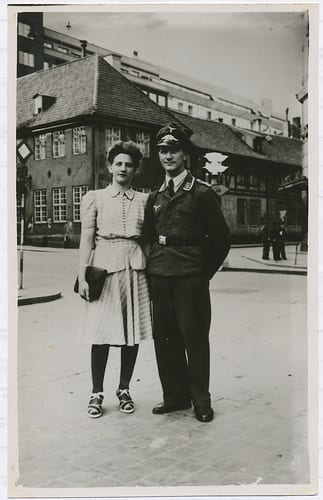
The war took a heavy toll on Stortorvets Gjæstgiveri. The property became badly worn, and after the war extensive restoration work was once again necessary. The restaurant was closed for eight months and reopened on 7 September 1949.
Frydenlunds Bryggeri retained ownership of Stortorvets Gjæstgiveri until 1978, when the property was purchased by Olav Thon.
An old building like this requires a great deal of care and attention, and after Olav Thon took over in 1978, it was once again time for a major refurbishment. Public interest was overwhelming. Loyal guests were concerned that the restaurant and café might lose their traditional character. But Thon, working in cooperation with the Directorate for Cultural Heritage, ensured that the building’s character remained unchanged. Much to the relief of the sceptics, the newly renovated restaurant was able to reopen in 1980.
As part of this restoration, the paintings that surround the first-floor restaurant were created. The works are signed by Charles Hoff from Østfold and are painted in an Expressionist style. Their motifs are drawn from the area in and around Grensen 1.
Charles Hoff was born on 9 May 1902 in Fredrikstad. He is best known as a pole vaulter and journalist, but he was also educated at the Norwegian National Academy of Craft and Art Industry in Kristiania. He also spent time at the National Academy of Fine Arts and attended art school in Paris, giving him a solid background in painting. His life story includes a remarkable sporting career, which was later overshadowed by a conviction for treason after the Second World War. During the war, he chose to side with the occupying regime and was sentenced in 1947 to nine years of forced labour. Charles Hoff continued working as a journalist and author for the rest of his life, although after the war he wrote under a pseudonym. He died in Oslo in February 1985 at the age of 82.
One incident that many people still remember took place on 14 May 1987. On that day, the police raided Stortorvets Gjæstgiveri in pursuit of members of the Blitz movement. Counter-terrorism police stormed the restaurant wearing helmets and accompanied by police dogs in order to arrest Stein Lillevolden and several other demonstrators following a protest at the American Embassy. The Blitz activists had entered Gjæstgiveriet for a warm cup of coffee when the police suddenly burst into the café. Shocked guests found themselves witnessing an unexpected drama that afternoon. The incident received extensive newspaper coverage, adding yet another chapter to the history of Grensen 1.
In earlier times, it was customary to visit Stortorvets Gjæstgiveri when farmers came to the city to sell their goods. The old agricultural trade has long since disappeared, but Stortorvets Gjæstgiveri remains a meeting place and the setting for strong traditions, such as the lutefisk season and the 17 May celebrations, when Kampen Janitsjar performs from the gallery.
And although it has been many years since rooms were available for rent here, the name has remained unchanged.
Want to know more?
Visit us at Grensen 1. Our walls are filled with history, and our staff are always happy to share stories from times gone by.